Monday, April 29, 2013

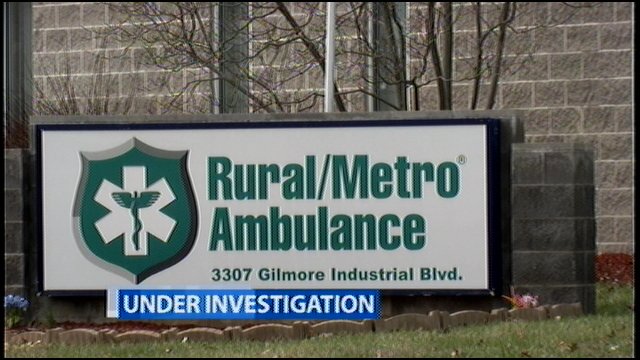
Santa Clara County EMS: Rural Metro Ambulance Slow Response Under Fire


"If they haven't got it right, they need to get it right, and they need to get it right quickly."

911 problem: Slow response violates Rural Metro's ambulance contract with Santa Clara County


A year and half after taking over 911 calls for 14 Santa Clara County cities and its vast unincorporated areas, the Rural Metro ambulance company has violated its contract by repeatedly responding too slowly to emergencies, has paid more than $4.7 million in fines and faces the threat of the first paramedics strike in recent history.
County Executive Jeff Smith said last week that with just one more contract violation of the type that occurred in 2011 and twice in 2012 the county may have to consider terminating the agreement with the Scottsdale, Ariz.-based company, which was notified Jan. 18 that it was in breach of contract. Rural Metro's performance is being closely watched in part because of the process under which it took over the county's ambulance contract from a longtime incumbent in 2011.
"We've made it clear to them we have remedies that go beyond fines," Smith said. "We've specifically told them that if you can't perform, we're going to cancel the contract and start all over again."
Although the ambulance company's failures to meet required response times of less than 12 minutes affected only a small fraction of the roughly 6,500 trips Rural Metro makes each month, Smith and other industry watchers called the breach significant.
"It's not significant to the point where any patients were put at risk," Smith said, "but weaknesses in the system could have been exploited by a disaster -- and therefore it's not acceptable."

After initially denying the violations occurred, Rural Metro has since submitted to county officials a "system enhancement plan," and its California spokesman Michael Simonsen notes: "We haven't been out of compliance since, and we don't plan on ever being out of compliance again."
Simonsen emphasized the late response times that led to the contract violation amounted to a few calls in October and December of last year -- and that in other months, Rural Metro responders exceeded the response time expectations. The county requires ambulances to arrive in less than 12 minutes 90 percent of the time.
"The breach occurred several months ago, it's almost old news at this point as far as I'm concerned," Simonsen said. "But we take it very seriously. There's no question that while it's literally a fraction of a percentage, literally a handful of calls, that caused us to fall below the 90 percent, we still take it extremely seriously."
Rural Metro took over the county's main ambulance contract for its 1.8 million residents in July 2011, after beating out the provider of more than 40 years, American Medical Response, with a far cheaper bid. The $375 million contract award followed years of study and a bitter battle between the two national ambulance chains that made the final cut.
The resulting 5-year contract is considered exceptionally tough, with fines for performance failure amounting to more than 10 times what the previous provider faced.
Rural Metro has paid hundreds of thousands of dollars a month in these fines, now totaling more than $4.7 million, for such things as failing to have three ambulances ready to deploy and for each minute they have been late to emergency scenes. That revenue goes into a special "trust fund" managed by county emergency medical services staff members. The trust fund has been used in part for public service announcements, training, conferences and staff recognition.
Just two weeks into the contract, Rural Metro failed to meet its response times in a northern section of the county, arriving within the 12-minute required time frame only 83 percent of the time. Similar violations occurred again in October 2012, when they came closer but fell short with an 89.57 percent rate. And then in the San Jose area in December, the response again fell below 90 percent; an 89.66 percent rate. The two violations within six months of each other triggered the January "material breach" of contract.
The 90 percent response time requirement is standard industrywide, and had not been missed by AMR in more than 10 years in the county, according to that company's west coast CEO, Tom Wagner.
Milpitas Fire Chief Brian Sturdivant said his community was excited when Rural Metro took over, because they were going to get an additional two "posts" -- which means ambulance workers stationed in a trailer at firehouses ready to deploy around the clock. Instead, Sturdivant's firefighters describe occasionally waiting longer for ambulances to come after the first responders arrive on crisis scenes. The "response time issues" he described include waiting "an extended amount of time with active CPR in progress on critical calls."
Meanwhile, labor unrest could add even more pressure to an already touchy situation. On April 17, Rural Metro's employees -- who include paramedics, emergency medical technicians, dispatchers and vehicle supply staff members -- voted 97 percent in favor of authorizing their bargaining team to call a strike as a last resort. The last time a similar vote was taken was in 1993 in Alameda County, and one occurred in San Mateo County in 1988.
As talks continue, both sides say they are hopeful an agreement will be reached. But backup plans are in place, company and county officials confirmed. Neither would elaborate on details.
The ambulance company's woes have yet to be discussed publicly by county supervisors.
But Supervisor Joe Simitian, the sole board member who is newly elected and did not vote on the ambulance contract, said he had cause for "serious concern" about Rural Metro's performance to date. "If they haven't got it right, they need to get it right," he said, "and they need to get it right quickly."

Notes: Just last year, the FBI launched a Medicaid and Medicare fraud investigation against Rural Metro Ambulance. The company was accused of billing for services it did not provide, going back to 2003.
Also DEA investigated Rural Metro Ambulance for opiate drug thefts.


Sunday, April 28, 2013

CAL FIRE Suspends All Open Burning In Ten Counties


 Effective at 8:00 a.m. on Monday April 29th, 2013, CAL FIRE has implemented a Proclamation suspending burning in all State and Local responsibility areas within the Following Counties: Alameda, Contra Costa, Santa Clara, San Mateo, Santa Cruz, Stanislaus, San Benito, Monterey, and Western San Joaquin counties.
Beginning Today Monday April 29th, 2013, CAL FIRE will suspend all open burning in Alameda, Contra Costa, Santa Clara, San Mateo, Santa Cruz, Stanislaus, San Benito, Monterey, and Western San Joaquin counties.
Open burning is any fire where the flame is exposed to the environment.

Officials say campfires are allowed as long as they are within organized campgrounds or on private property, and the landowner has given permission. They must be set up so they won't spread to nearby vegetation.

Industrial burning is also allowed as long as CAL FIRE officials inspect the burn site and issue a permit.

CAL FIRE declared the burn ban because it's a proven technique for preventing large fires from starting.

 Effective at 8:00 a.m. on 
Monday April 29th, 2013, CAL FIRE has implemented a Proclamation suspending burning in all State and Local responsibility areas within the Following Counties: Alameda, Contra Costa, Santa Clara, San Mateo, Santa Cruz, Stanislaus, San Benito, Monterey, and Western San Joaquin counties.


First Responders to the September 11 attacks have a 15 percent higher rate of cancer than the general population

STUDY: 9/11 First Responders Have Higher Rates Of Cancer Than The General Population
Responders to the September 11 attacks have a 15 percent higher rate of cancer than the general population, according to a new study published in the Environmental Health Perspectives journal.
The study examined data from 20,984 first responders in the seven years after the 9/11 attack, a short time period that the study’s authors say makes the findings more compelling. Since certain cancers often take decades to develop, an increased cancer rate in responders after just seven years could mean many more cases could develop among responders as time passes.
Though the link between cancer and Ground Zero exposure has been historically controversial— federal compensation for 9/11 responders who developed cancer was held up by debates for about a year before being authorized in 2012 — the claim that exposure to Ground Zero toxins resulted in illnesses for responders is widely accepted. Studies have found that rescue workers are likely to suffer from respiratory illnesses, depression, and Post Traumatic Stress Syndrome — ailments resulting in part from the multitude of harmful substances found in Ground Zero dust and debris. As CNN reported in 2011:
Researchers have reported the presence of hundreds of compounds in ground zero dust, among them known carcinogens. Potential cancer-causing agents such as asbestos that coated the Trade Center buildings’ lower columns, and benzene, a component of jet fuel that caused uncontrollable fires when planes barreled into the twin towers, have been a cancer concern for researchers.
This latest research to link cancer to Ground Zero exposure is consistent with others of its kind: in 2011, a study found firefighters who worked at Ground Zero were 19 percent more likely to develop cancer than firefighters who didn’t. In 2012, a study found a 14 percent increase in cancers among 9/11 responders and people who lived or worked near Ground Zero — a finding that, at the time, was said to be insignificant. Though an increase of 14 to 19 percent isn’t huge, the similarity of the three study’s results makes clear that the link between Ground Zero toxins and cancer could be stronger than previously thought, and should continue to be monitored.
According to the study, thyroid, prostate, and blood cancers like leukemia and lymphoma saw some of the highest incidence rates among 9/11 responders. The incidence of thyroid cancer was 239 percent higher than it is in the typical population, while blood cancers were 36 percent higher and prostate cancer was 21 percent higher. Though the $4.3 billion federal compensation fund for 9/11 victims and responders provides coverage for more than 50 types of cancers, prostate cancer is not one of them — a fact that makes the study’s finding on the disease especially significant.
Source: http://thinkprogress.org/health/2013/04/24/1908761/study-first-responders-cancer/

Mow your lawn get a check, CAL FIRE pays large landowners to maintain property


 El Dorado County leaders question supervisor's fire prevention reimbursements

Read more here: http://www.sacbee.com/2013/04/28/5377373/el-dorado-county-leaders-question.html#storylink=cpy


By Richard Chang

El Dorado County Supervisor Ray Nutting is under fire after reports surfaced that he took state money for clearing brush on his 340-acre property.

Several local leaders in recent days have spoken out against Nutting, whom they accuse of subverting state funds for personal use.

"I want the public to know that the Board of Supervisors is not going to sweep things under the rug," Supervisor Ron Briggs, the board's chairman, said Friday.

At issue is whether Nutting legitimately obtained taxpayer dollars for fire prevention work he did on his own Happy Valley Road property in Somerset.

Nutting has denied any wrongdoing, adding that he will release new information this week to clear his name.

"The accusations and political spin these people are putting on is absolutely incorrect," Nutting said. "I had no clue this had gone political."

The supervisor, a Republican, applied for the funds through the California Forest Improvement Program, which is administered by the state's Department of Forestry and Fire Protection through local conservation agencies. Under the program, landowners with plots between 20 and 5,000 acres can seek reimbursement – usually 75 percent – for the cost of fire prevention work, such as brush clearing.

The invoices Nutting submitted show that the state paid a total of $70,000 for two projects in 2003 and 2009. A third proposal is pending and will cost just under $50,000.

Cal Fire spokesman Daniel Berlant noted that the program allows landowners to get paid for doing work themselves on their own property.

"Our ultimate objective is stopping or slowing down fires," he said. "It doesn't matter whether you do it yourself or hire a contractor."

One controversy stems from the way Nutting applied for reimbursements. A May 2009 invoice appears to have been written by the supervisor himself, according to public records obtained by The Bee.

El Dorado County Auditor-Controller Joe Harn said he believes the invoice is invalid and violates the California False Claims Act.

"This appears to be an intentionally misleading bogus document," Harn said. "You don't submit an invoice to yourself."

This isn't the first time red flags have been raised about the legitimacy of reimbursement requests submitted through the program.

Following an audit, the state Department of Finance issued a recommendation in December 2009 calling on the Sierra Coordinated Resources Management Council – the local agency in charge of distributing the grants – to "require landowners to provide cancelled checks, bank statements or other appropriate evidence for claimed costs."

"Without proof of actual costs by landowners, grant funds could be use for purposes not allowed by the program," the department wrote.

Since then, Cal Fire has asked the Sierra Coordinated Resources Management Council to require detailed receipts for all reimbursement requests.

In addition, Berlant said other checks and balances exist to prevent fraud, including a final inspection by Cal Fire officials before payment is made to the landowner.

As a part of the fallout from the controversy, the El Dorado County District Attorney's Office has launched its own investigation into the matter. The DA declined to comment on the case Friday.

The state has reimbursed property owners for fire prevention work since the late 1970s, Berlant said.

Since 1999, the state has distributed about 1,000 grants for fire prevention work to various individuals. The funding source varies year to year, but most recently came from Proposition 40, a measure passed by voters in 2002 that provides local grants to protect California's water and air.

"It doesn't matter who you are as an individual," Berlant said, noting that there is nothing precluding elected officials from taking the money. "This is a mutually beneficial program that helps landowners and the state reduce fire risk."


Source: Sacramento Bee http://www.sacbee.com/2013/04/28/5377373/el-dorado-county-leaders-question.html


Read more here: http://www.sacbee.com/2013/04/28/5377373/el-dorado-county-leaders-question.html#storylink=cpy


Fire Season Starting Up In Northern California

 San Jose: Five-acre blaze on Communications Hill sparked by homeless encampment
SAN JOSE -- A cooking fire at a homeless encampment sparked a grass fire on Communications Hill on Saturday afternoon, but it was corralled before it caused any injury or serious damage, the San Jose Fire Department said.

Firefighters were called at 1:48 p.m., but their response was slowed because their equipment that traverses hilly terrain wasn't fully operational since fire season doesn't start for at least another month, said fire Capt. Reggie Williams.

The blaze consumed five acres before firefighters -- with the help of water drops from a Cal Fire helicopter -- brought it under control at 3:32 p.m. No injuries were reported, and nothing other than vegetation burned.

"It was a difficult fire because it was wind-driven, and because of the terrain," Williams said. "Luckily the grass is still fairly green out there"

And
 Firefighters lend a hand with controlled burns

At least two controlled, permitted burns in Sonoma and Mendocino counties got a little bit out of control Saturday afternoon, requiring firefighters’ quick response to extinguish them, officials said.

One of the fires was located on a stretch of Gehricke Road, near a vineyard, according to Cal Fire officials. That fire burned about three acres and was mostly contained by 7 p.m.

The other fire was off Old Toll Road and Adobe Creek Road, near the Mendocino/Lake County border. Cal Fire officials said that fire grew to at least 10 acres, twice the area of the permitted burn.

A Mendocino County resident also reported spot fires near the Hopland Grade, at mile marker 8.2. The resident said he reported the fire to Cal Fire at about 4 p.m. but that they were slow to respond.

He said that 45 minutes after reporting the fire it had grown to six separate fires. A Mendocino Cal Fire representative said Saturday night that the fire was a controlled burn that never got out of hand.

1st story source: http://www.mercurynews.com/breaking-news/ci_23124213/san-jose-encampment-fire-sparks-5-acre-blaze
2nd story source: http://www.pressdemocrat.com/article/20130427/ARTICLES/130429620/1033/news?Title=Firefighters-lend-a-hand-with-controlled-burns

Saturday, April 27, 2013

CZU Roaring Camp? Henry Cowell Wildfire In Social Media Pictures

A small wildfire broke near Santa Cruz in Henry Cowell State Park near Roaring Camp here is the story in social media pictures Pictures were shared thru twitter and tweeted in a variety of formats from Flickr to Twitpic starting with @JudyDarnell

COPTER 902 dipping bucket Henry Cowell Meadow
Picture by Judy Darnell 


CAL FIRE CZU Inmate Crews Heading Out To Cut Some Line
Picture by Judy Darnell

Helicopter water drop @Larry Darnell ‏@CALandscapeArt
roaringcamp #wildfire 4.27 #SLV @CalFireNews
From twitter user @CALandscapeArt Flickr account
CALandscapeArt

 Roaring Camp Railroad Santa Cruz Mountains Felton, CA
CAL FIRE CDF Helicopter 902 arrives in Henry Cowell Meadow. Bucket is deployed and it takes off to gather water. Fire trucks and SC Sheriff staging area @Roaring Camp. Fire Crew arrives. Helicopter sets down after multiple drops. Ground crew deployed.
https://twitter.com/JudyDarnell

SBNF: Angelus Oaks Hazmat (Fuel Spill) / Road Closure

Cold Creek (Hazardous Materials)
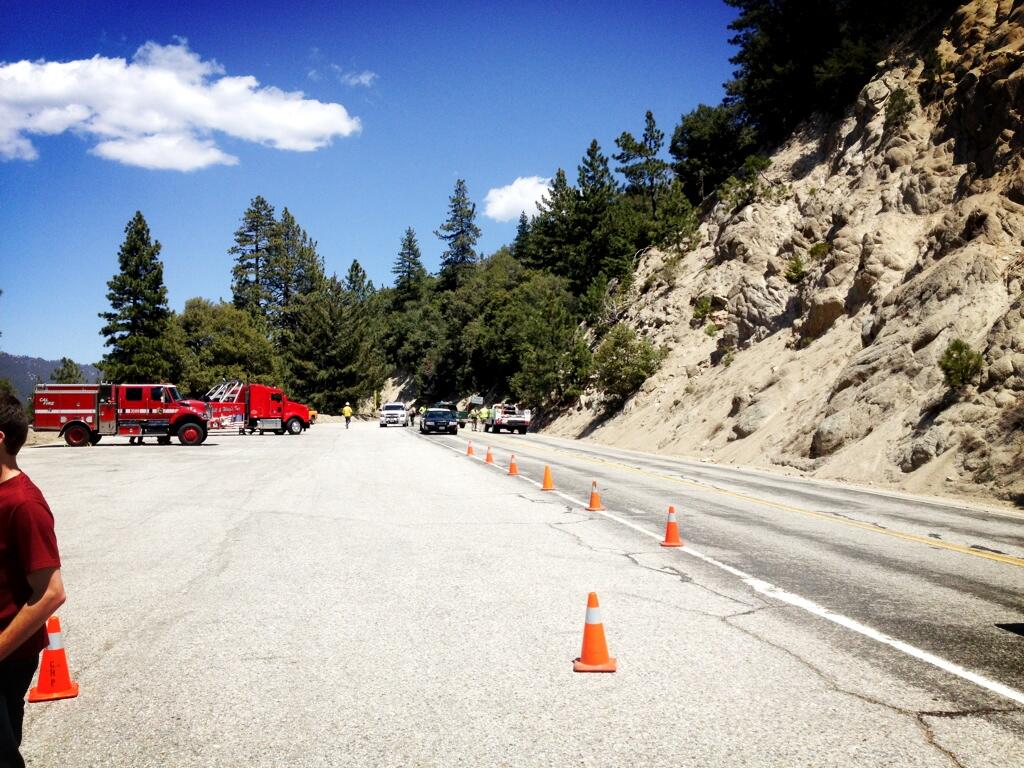
 At 9:35am on April 26, 2013 a tanker truck carrying gasoline and diesel fuel overturned on State Route 38, one mile east of Angelus Oaks.
 
The rear trailer of the tanker truck has spilled approx. 2900 gallons of gasoline and 1700 gallons of diesel fuel onto the roadway.
 
Fuel from the spill has entered Cold Creek and has been detected in the Santa Ana River. Hazardous materials and environmental cleanup responders from federal, state and local government are on scene assessing the impacts and damage to the highway as well as Cold Creek and the Santa Ana River.
 
Closures: State Highway 38 is closed to all traffic from Angelus Oaks to Camp Cedar Falls near Barton Flats. Middle Control Road is closed from State Highway 38 to Forest Road 1N09 The Santa Ana River Trail is closed from Angelus Oaks to Glass Road. Forest Visitors to the Barton Flats and Big Bear area will need to use State Highway 330 via Running Springs or State Highway 18 via Lucerne Valley

Basic Information
Incident Type Hazardous Materials
Cause Traffic Collision
Date of Origin Friday April 26th, 2013 approx. 09:30 AM
Location East of Angelus Oaks
Incident Commander Koontz
Total Personnel 52


Friday, April 26, 2013

TCU: CAL FIRE Burn Permits Required Starting Wednesday, May 1st by 8 a.m. in Tuolumne and Calaveras Counties.

CAL FIRE'S BURN RESTRICTIONS AND BURN PERMITS

During certain times of the year residential landscape debris burning of dead vegetation is allowed. However, homeowners should always check with their local CAL FIRE station and local air quality management agency before burning. In many area burn permits may be required. For more information on debris burning safety download an educational fact sheet.

To find out if it is a permissive burn day in your area, contact your local air quality district. Contact information may be found at the State Air Resources Board website.

Below is CAL FIRE's list of stations were you can get permits which will be available only during business hours, Monday through Friday:

•CALFIRE Headquarters, 785 Mountain Ranch Road, San Andreas (closed from noon to 1PM)
•Twain Harte FFS, 22978 Meadow Drive, Twain Harte
•Station 51, 1950 Hillsdale Drive, Mono Village, Sonora
•Groveland CSD, 18930 Highway 120, Groveland
•Ebbetts Pass FPD, 1037 Blagen Road, Arnold

Below are Cal Fire's requirements for debris burns:
  • Burn permit terms include limiting pile size to a maximum of four feet by four feet (four feet in diameter, and four feet high) and clearing down to bare mineral soil 10 feet from the outer edges of burn piles.
  • Burn hours will remain open. Weather conditions will be monitored daily and when conditions warrant, burn hours will be restricted or burning will be suspended.
  • Outdoor burning may be done ONLY on permissive burn days. Remember burn day status is determined on the basis of air quality: how quickly smoke will disperse. Therefore, many permissible burn days are very windy.

You are also required to check to make sure it is a permissive burn day. 

"Even if it is a permissible burn day never burn on windy days. Remain in attendance of your burn project and have tools and water close by in order to suppress any escape from your burning operation," says 
CAL FIRE Acting Unit Chief Steve Lawshe.
CAL FIRE officials said they have already seen an early increase in fire activity. Since the beginning of the year, CAL FIRE has responded to more than 680 wildfires, which is more than 200 over the average for this time of year.
CAL FIRE said due to the low rainfall levels across the state from January to April, this year is likely to go down as one of the driest ever.


"Our firefighters have responded to an increased number of wildfires due to the very little rainfall we have received over the past few months," said CAL FIRE Director Chief Ken Pimlott, in a statement.

The state Department of Water Resources in its late March survey found that snowpack is just 52 percent of average statewide.

CAL FIRE also urges residents to create and maintain 100 feet of defensible space around all structures as required by law.

CAL FIRE: Increased number of wildfires due to the very little rainfall, snowpack is just 52 % of average statewide

CAL FIRE Stresses Preparedness Due to Lack of Rain
Fire Activity up Over 45 Percent
An early increase in fire activity has CAL FIRE looking at the lack of rainfall as an indicator of a potentially higher fire threat this summer. Since the beginning of the year, CAL FIRE has responded to over 680 wildfires, which is more than 200 over the average for this time of year.
“Our firefighters have responded to an increased number of wildfires due to the very little rainfall we have received over the past few months,” said Chief Ken Pimlott, CAL FIRE director. “Last week in Southern California we increased our staffing and moved our airtankers to their bases, which was needed as we saw several large wildfires over the weekend.”
In late March, the Department of Water Resources (DWR) conducted this year’s next-to-last snow survey and the low levels have CAL FIRE concerned about the impact to this year’s fire season. This final survey found that snowpack is just 52 percent of average statewide, according to the Department of Water Resources. Due to the low rainfall levels across the state from January to April, this year is likely to go down as one of the driest ever.
The lack of winter rains has resulted in dry conditions across the state leading to a number of unseasonably large wildfires that have already threatened people, homes and the state’s watershed. Over the past few months CAL FIRE crews responded to an increased number of large wildfires including the 296 acre Becks Fire in Lake County, the River Fire in Inyo County which grew to 406 acres and most recently, the 311 acre Jurupa Fire in Riverside County.
“In many other areas of the state we are in the process of training our seasonal firefighters and monitoring weather conditions closely to determine our staffing levels,” said Chief Pimlott. “While we are busy transitioning into fire season, this is the time we want residents to begin preparing their homes for fire season by creating 100 feet of Defensible Space.”
CAL FIRE is asking Californians to prepare for wildfires by taking these actions:
  • Maintain 100 feet of Defensible Space
  • Remove all dead plants, grass, and weeds from within 30 feet of your home
  • Trim trees 6 feet from the ground
  • Remove all leaves, pine needles and debris from roofs
  • Create an Evacuation Plan in case of a wildfire
For more information on preparing for wildfires visit: www.ReadyForWildfire.org.


CAL FIRE NEWS RELEASE California Department of Forestry - BURN PERMITS REQUIRED MAY 1ST, 2013

CAL FIRE NEWS RELEASE Lassen-Modoc-Plumas Unit
California Department of Forestry - CAL FIRE

BURN PERMITS REQUIRED MAY 1ST, 2013

Susanville – Effective Wednesday, May 1st, 2013 the California Department of Forestry and Fire Protection (CAL FIRE) Lassen – Modoc – Plumas Unit will require dooryard burning permits for residential burning within Lassen, Modoc and Plumas Counties

Burning permits are required from May 1st, 2013 to midnight June 30th, 2013 for all residential burning on State Responsibility Area Lands. 

• Burning can only be done on permissive burn days. To find out if it is a permissive burn day, contact your local Air Pollution Control District (APCD). 

 Lassen County – (530) 257-2876 or 257-BURN

 Modoc County – (530) 233-6401

 Plumas County –

• Portola: (530) 832-4528 Quincy: (530) 283-3602
• Greenville: (530) 284-6520 Chester: (530) 258-2588

• At midnight June 30, 2013, a burning suspension will go into effect until the end of the declared fire season or until lifted by the Unit Chief.
• Only natural vegetative material such as leaves, pine needles and tree trimmings may be burned.
• Household garbage may NOT be burned.
• Do not burn on windy days.
• You cannot burn in a burn barrel unless you have received authorization from your APCD.
• Burning can only be done during permissive times.

o Burn hours for Lassen County are as follows:
May 1, 2013 through May 31, 2013 - Open Hours
June 1, 2013 through June 30, 2013 - 5 a.m. to Noon
o Burn hours for Modoc County are as follows:
May 1, 2013 through May 31, 2013 – Open Hours
June 1, 2013 through June 30, 2013 – 7 p.m. to 10 a.m.

o Burn hours for Plumas County are as follows:
May 1, 2013 through May 31, 2013 – Open Hours
June 1, 2013 through June 30, 2013 – 5 a.m. to 11 a.m.

• You must have a signed permit in your possession while you are burning and you are responsible for maintaining control of your fire at all times.
• Possession of a permit does not protect you if your burn escapes. You are still liable for any suppression costs.
• If a burn escapes your control, you should seek help immediately. Wildfires can spread very quickly. A fast response from the fire department can reduce suppression cost considerably. Remember, you may be billed for suppression costs, so the sooner you seek help the better the outcome may be.
• Simple common sense can greatly reduce the chance of an escape. If you don’t feel it’s safe to conduct a burn, then don’t.

For more information on burn permit requirements, contact your local fire department
CFN - California Fire News 2013 
 -  

Twitter Buttons

****REMINDER**** Every fire has the ability to be catastrophic. The wildland fire management environment has profoundly changed. Growing numbers of communities, across the nation, are experiencing longer fire seasons; more frequent, bigger, and more severe, fires are a real threat. Be careful with all campfires and equipment.

"I am a firm believer in the people. If given the truth, they can be depended upon to meet any national crisis. The great point is to bring them the real facts, and beer." --Abraham Lincoln

View blog top tags
---------------------
CLICK HERE TO GO BACK TO TOP OF CALIFORNIA FIRE NEWS HOME PAGE

Subscribe via email to California Fire News - Keep track of Cal Fire News

Enter your email address:

Delivered by FeedBurner