Thursday, January 24, 2013

Self-Contained Breathing Apparatus Remaining Service-Life Indicator Performance Requirements

 A Rule by the Health and Human Services Department on 01/14/2013
This final rule is effective February 13, 2013.


ACTION

Final Rule.

SUMMARY

On June 25, 2012, the Department of Health and Human Services (HHS) published a notice of proposed rulemaking proposing to update respirator approval standards in response to a petition to amend our regulations, current requirements for self-contained breathing apparatus (SCBA) remaining service-life indicators or warning devices. These indicators are built into a respirator to alert the user that the breathing air provided by the respirator is close to depletion. In this final rule, HHS responds to public comment on the proposed rule and revises the current standard, employed by the National Institute for Occupational Safety and Health (NIOSH) located within the Centers for Disease Control and Prevention (CDC), to allow greater flexibility in the setting of the indicator alarm to ensure that the alarm more effectively meets the different worker protection needs of different work operations. This final rule sets a minimum alarm point at 25 percent of the rated service time and allows the manufacturer to offer remaining service life set point at a higher value or values appropriate to the purchaser's use scenario.

UNIFIED AGENDA


TABLE OF CONTENTSBack to Top

DATES:Back to Top

This final rule is effective February 13, 2013.

FOR FURTHER INFORMATION CONTACT:Back to Top

Jonathan Szalajda, NIOSH National Personal Protective Technology Laboratory (NPPTL), P.O. Box 18070, 626 Cochrans Mill Road, Pittsburgh, PA 15236, (412) 386-5200 (this is not a toll-free number).

SUPPLEMENTARY INFORMATION:Back to Top

The preamble to this final rule is organized as follows:
I. Public Participation
II. Background
III. Summary of Final Rule and Response to Public Comments
IV. Regulatory Assessment Requirements
A. Executive Orders 12866 and 13563
B. Regulatory Flexibility Act
C. Paperwork Reduction Act
D. Small Business Regulatory Enforcement Fairness Act
E. Unfunded Mandates Reform Act of 1995
F. Executive Order 12988 (Civil Justice)
G. Executive Order 13132 (Federalism)
H. Executive Order 13045 (Protection of Children From Environmental Health Risks and Safety Risks)
I. Executive Order 13211 (Actions Concerning Regulations That Significantly Affect Energy Supply, Distribution, or Use)
J. Plain Writing Act of 2010
V. Final Rule

I. Public ParticipationBack to Top

Interested persons or organizations were invited to participate in this rulemaking by submitting written views, arguments, recommendations, and data. Comments were invited on any topic related to this proposal, but comments were specifically solicited regarding whether: (1) 25 percent of the rated service time of the respirator is an appropriate default setting for the indicator to alarm; (2) the rule should specify an upper limit that would require that the indicator be set to alarm no earlier than a set amount, such as 50 percent of rated service time; and (3) there are possible emergency or rescue scenarios for which one would want an indicator to alarm at 50 percent or more of the rated service time?
HHS received 8 submissions from the public in response to this rulemaking. Commenters represented local fire departments, manufacturers of self-contained breathing apparatus (SCBA) used in the fire service, and a firefighters' union. A summary of comments and the HHS response are found in Section III, below.

II. BackgroundBack to Top

In 2003, NIOSH received a petition from David Bernzweig of the Columbus (OH) Professional Firefighters International Association of Fire Fighters (IAFF) Local 67 requesting that the agency initiate rulemaking to amend 42 CFR 84.83(f). [1] The current rule requires that the self-contained breathing apparatus (SCBA) service-life indicator (also known in the firefighter community as an end-of-service-time indicator (EOSTI), or a low-air alarm) give an alarm within the 20 to 25 percent range. Stakeholders in agreement with Mr. Bernzweig requested that HHS eliminate the lower value (20 percent) and require the indicator to alarm no later than at 25 percent of rated service time. NIOSH considered the request and facilitated discussion among stakeholders by holding a public meeting to discuss underlying issues and technical matters on December 2, 2008, in Pittsburgh, Pennsylvania (73 FR 65860, November 5, 2008). [2]
The National Fire Protection Association (NFPA), which sets standards for personal protective equipment used in the fire service, initiated an effort in 2008 to develop consensus on the matter and recently decided to amend NFPA 1981: Standard on Open-Circuit Self-Contained Breathing Apparatus (SCBA) for Emergency Services[3] to require that the indicator alarm at 33 percent.
For reasons discussed in the notice of proposed rulemaking published in the Federal Register on June 25, 2012 (77 FR 37862), HHS finds that amending § 84.83(f) to allow greater latitude with regard to setting the indicator alarm would not reduce the amount of protection afforded to firefighters and other SCBA users. In fact, HHS has determined that specifying a minimum setting of 25 percent and allowing manufacturers to offer different alarm settings more suited to purchasers' use scenarios will result in a more meaningful alarm that may offer greater protection for users.

III. Summary of Final Rule and Response to Public CommentsBack to Top

The amendment to 42 CFR 84.83(f) establishes that the low-air indicator must activate at a minimum setting of 25 percent of the SCBA's rated service time. If a purchaser has determined that an earlier alarm will benefit the specific occupational purpose for which the respirator is to be used, the purchaser may request that the manufacturer offer a remaining service-life indicator alarm set-point at a higher value (or values) appropriate to the purchaser's use scenario. If the manufacturer chooses to offer a respirator with a different set-point (at no less than 25 percent of the SCBA's rated service time), the modified respirator must be approved by NIOSH. Purchasers may also have the indicator setting modified for already fielded SCBA units by an authorized representative of the manufacturer, provided that the respirator model has received a new NIOSH approval specifying the new alarm set-point.
The final rule also codifies a long-standing NIOSH policy requiring the indicator for demand and pressure-demand open-circuit (OC)SCBA to alarm continuously until the respirator's breathing air supply is depleted.
Changes to the proposed rule text are made in response to public comment, to clarify our overall intent; to specify that the requirement for continuous alarming is intended for open-circuit, demand and pressure demand units only; and to require that manufacturers identify the indicator setting on each unit. Specific comments and responses are discussed below. The rule text is also amended slightly to better comply with Federal plain language requirements.
Comment: Two commenters were fully supportive of the rulemaking. One commenter stated that requiring fire service respirators to alarm when breathing air reaches 25 percent “does not serve the needs or interests of today's fire service.” According to the commenter, “[t]here is no safety purpose served by not allowing an earlier set point for the EOSTI. An earlier set point would allow for a greater margin of safety for the end user. Not having an earlier set point would continue to place firefighters at risk by not having an adequate air reserve when the EOSTI activates.” The commenter further agreed that the alarm should not be field-adjustable and that purchasers should be able to specify the setting at the time of purchase or service.
HHS response: We thank these commenters for their response.
Comment: We received two comments that appeared to confuse the standard proposed by HHS (a default of 25 percent unless the purchaser requests a different, higher, value) with the standard being developed by NFPA (alarm activation at 33 percent). One commenter expressed approval for giving purchasers the ability to set the remaining service-life indicator alarm between 33 percent and 50 percent. The other commenter expressed disapproval for changing the indicator to activate at 33 percent rather than 25 percent.
HHS response: The amended standard is responsive to the various concerns. Manufacturers are not required to modify existing approvals to comply with this rule; they may continue to market and sell respirators approved under the current standard, indefinitely. If, in response to purchaser needs, the manufacturer chooses to market and sell respirators that activate at the 25 percent minimum requirement or earlier, the manufacturer must obtain a new or revised NIOSH approval.
Comment: One commenter supported the inclusion of a 50 percent upper limit for the alarm set-point; other commenters neither supported nor opposed the upper limit.
HHS response: We did not receive justification for applying a 50 percent upper limit. It is conceivable that some use scenarios might warrant an earlier alarm point. Accordingly, we have not revised the proposal in response to the comment.
Comment: One commenter suggested that allowing individual fire departments to determine their own remaining service-life indicator setting may cause “incident related” problems. The commenter further stated that there was no discussion in the notice of proposed rulemaking about the use of the heads-up-display for monitoring breathing air depletion or the reliance on teamwork to maintain situational awareness.
HHS response: This comment raises training issues regarding the users' response to an alarm being activated. We understand that a change in the mechanical alarm setting may necessitate a change in training protocols. However, training for the proper use of these respirators is outside the scope of this rulemaking.
Comment: One commenter agreed with the intent of the proposed rule text but suggested a number of edits. The commenter stated that the proposed rule text did not account for the distinction between respirator models whose alarms are designed either to activate electronically or activate using the device's compressed air. According tothe commenter, “[i]f the EOSTI is activated electrically then the alarm can sound continuously until the depletion of the breathing air supply. If the EOSTI is activated using the compressed air in the system then at some point the alarm sound will decrease in decibels and even cease to sound before the breathing air is depleted.” The commenter suggested adding the text “if electrically controlled or to a pressure of 10 bar (145 psi) if operated by the compressed air in the system” to the text in § 84.83(f).
HHS response: The purpose of the alarm is to advise the user that the system is depleting its air supply. While the rule text does not specifically identify models that alarm either electronically or using compressed air, we intend for the indicator to alarm until the air supply runs out in order to warn the user of the situation so they can take appropriate action for their setting. That the indicator may not continue to alarm until the air supply is absolutely depleted is understood and is evaluated in NIOSH testing (see NIOSH standard testing procedure RCT-ASR-STP-0124, Determination of Remaining Service-Life Indicator—Open-Circuit, Demand and Pressure-Demand, Self-Contained Breathing Apparatus, at http://www.cdc.gov/niosh/npptl/stps/pdfs/RCT-ASR-0124.pdf, which will be updated to comport with this rulemaking).
Comment: Another comment referred to long duration closed-circuit breathing apparatus (CCBA), which are also regulated under Subpart H in Part 84. The commenter stated that “it can be interpreted that even long duration CCBA would also need to meet the proposed new requirements. For example, this would require that a CCBA with a rated service time of 4 hours would need to have the EOSTI alarm continuously for 1 hour and this would be annoying to the users and may affect their activities in a negative manner.” The commenter accordingly suggested that the text in § 84.83(f) should address only open-circuit devices, and offers a new § 84.83(g) which suggests that, for closed-circuit devices, the indicator should alarm for a limited time period when the reserve capacity of the apparatus is reached, and a continuous alarm when a prescribed pressure is reached.
HHS response: HHS did not intend for the continuous alarm requirement to pertain to long-duration closed-circuit devices. However, the open-circuit demand and pressure-demand devices are expected to alarm continuously once activated. Accordingly, we have amended the final rule text to require that only open-circuit demand and pressure-demand (as described in 42 CFR 84.70(a)(2)(i) and 42 CFR 84.70(a)(2)(ii)) respirators need to alarm continuously.
Comment: One commenter suggested that only purchasers who are required by a third-party standard to request an alarm set-point other than the default 25 percent be allowed to request a different alarm setting.
HHS response: We do not agree that the 25 percent default value should only be raised when prescribed by a third party standard. While § 84.83(f) is amended in response to a petition on behalf of the U.S. fire service, we note that OC-SCBAs are used by industries and in occupational settings other than firefighting. We intend to maintain flexibility with regard to the alarm setting requirement to avoid further limitations on the ability of purchasers to request an alarm set-point appropriate to their use scenarios and the ability of manufacturers to offer such respirators.
Comment: One commenter stated that the terms `default' and `adjusted' used in the rule summary are vague and “cause policy or test requirement issues.” The commenter recommended that the word `default' be removed because it “implies the product must meet the minimum setting and shall be capable of fulfilling a higher setting. We believe this is not the intent of the proposed changes and can lead to unnecessarily design-restrictive interpretations.” The commenter requested that, in addition to adjustable designs, the rule should “allow flexibility to permit others such as dedicated set point designs.” The commenter suggested that the rule text should be modified to state: “Each remaining service-life indicator or warning device shall give an alarm when the remaining service life of the apparatus is reduced to the manufacturers' specified range and shall alarm continuously until the breathing air supply approaches depletion. The manufacturer can specify either a set point of 25 or 33 percent of its rated service time in response to the user's specific request.”
HHS response: The terms `default' and `adjusted' do not occur in the rule text; however, HHS does intend for the product to be able to meet the 25 percent value as the minimum setting and/or any higher setting requested by the purchaser. During performance testing for approval, NIOSH will test the alarm setting identified by the manufacturer in its request for approval of the respirator system. If the manufacturer does not identify an alarm setting, the indicator will be tested to show that it activates at the value of 25 percent of its rated service life.
The rule does not specify or restrict how manufacturers must comply with its provisions; manufacturers who find it in their best interest may offer specific set-points. Manufacturers are not required to produce a device that is adjustable to different users' needs, and can continue to market and sell SCBA models approved by NIOSH prior to the effective date of this rule. However, should the manufacturer wish to modify such a model for any reason, including a change to their service-life indicator set point, the manufacturer is required to apply to NIOSH for a new approval.
Additionally, in evaluating this comment, HHS determined that the user should be able to readily identify a respirator's alarm setting to distinguish models from one another. Models that meet the revised performance requirements of this rule should have labels and/or markings that identify the alarm setting for that particular model. At the discretion of the manufacturer, these markings could be addressed as part of the cautions and limitations associated with these devices, or as an additional label. In accordance with this determination, the final rule text is amended to address labels and/or markings.
Comment: One commenter recommended that 42 CFR 84.82 “include an additional section for a 33 percent” remaining service-life indicator. According to the commenter, “[a]llowing manufacturers the ability to utilize the same gauge for both alarm set points will reduce cost and complexity within the market.”
HHS response: HHS has determined that the provisions in 42 CFR 84.82 are sufficiently flexible to allow manufacturers to produce gauges that accurately indicate the amount of breathing air contained in a unit.
Comment: HHS received one comment on the E.O. 12866 and E.O. 13563 analysis in Section IV.A., below. According to the commenter, “[i]t is important to realize that additional costs for multiple or adjustable set points are inevitable. In addition to added design and documentation costs, options introduced into production will increase assembly and inspection times. Inventory costs increase with optional material warehousing.* * *. While they may be independent, other pressure gauges and electronic systems must be designed to correlate with the RSLI and the system(s) must be thoroughly verified. Differing RSLI settings may require differing gauge faces and electronics/programming designs tomaintain correlation. For all these reasons, costs will increase.”
HHS response: The commenter misunderstands the requirement. HHS does not require manufacturers to produce products with new features allowing for adjustment of the service life indicator alarm set point, or for various product models with different set points. Any manufacturer can choose to meet product demand by either manufacturing products with fixed set points or by manufacturing products with manufacturer-adjustable set points. Alternatively, the manufacturer can choose to take no action, and continue to sell respirators under existing NIOSH approvals. HHS is reducing the longstanding constraint on these product designs for a single alarm set point. Accordingly, we continue to conclude that there are no costs associated with this rulemaking, and solely benefits in terms of greater flexibility for manufacturers to meet the diverse needs of their customers.

IV. Regulatory Assessment RequirementsBack to Top

A. Executive Orders 12866 and 13563

Executive Orders 12866 and 13563 direct agencies to assess all costs and benefits of available regulatory alternatives and, if regulation is necessary, to select regulatory approaches that maximize net benefits (including potential economic, environmental, public health and safety effects, distributive impacts, and equity).
This final rule is not being treated as a “significant” action under E.O. 12866. It modifies the settings for an indicator required by current regulation, as well as codifies a long-standing policy of requiring that the OC demand and pressure demand SCBA indicator alarm continuously once it has begun. The current rule requires that a remaining service-life indicator activate when the breathing air provided by an OC demand and pressure demand SCBA reaches between 20 and 25 percent of its rated limit. The final rule replaces the range with a default value of 25 percent, and allows manufacturers to offer indicator set-point values at a higher limit than 25 percent of remaining breathing air.
All approved OC demand and pressure demand SCBA models have a remaining service-life indicator for which alarm limits are set during manufacturing. Allowing respirator manufacturers to offer a respirator with an earlier activation set-point value will ensure that the alarm more effectively meets the varying worker protection needs of different work operations.
Although HHS determined that there are no costs and only benefits associated with this rulemaking, we received one comment on this economic analysis, summarized above. As discussed above, HHS continues to conclude that there are no costs associated with this rulemaking, and solely benefits in terms of greater flexibility for manufacturers to meet the diverse needs of their customers.
The rule does not interfere with State, local, or tribal governments in the exercise of their governmental functions.

B. Regulatory Flexibility Act

The Regulatory Flexibility Act (RFA), 5 U.S.C. 601 et seq., requires each agency to consider the potential impact of its regulations on small entities, including small businesses, small governmental units, and small not-for-profit organizations. As discussed above, all OC demand and pressure-demand SCBA models are equipped with a remaining service-life indicator that will not require additional expenditure of resources to set at the activation limit. This final rule allows small organizations such as local fire departments to request an earlier indicator activation set-point when purchasing new devices from the manufacturer. The Secretary of HHS has certified to the Chief Counsel, Office of Advocacy of the Small Business Administration, that this rule does not have a significant impact on a substantial number of small entities. Accordingly, no regulatory impact analysis is required.

C. Paperwork Reduction Act of 1995

The Paperwork Reduction Act (PRA), 44 U.S.C. 3501 et seq., requires an agency to invite public comment on and to obtain OMB approval of any regulation that requires 10 or more people to report information to the agency or to keep certain records. This rule does not contain any information collection requirements; thus HHS has determined that the PRA does not apply to this rule.

D. Small Business Regulatory Enforcement Fairness Act

As required by Congress under the Small Business Regulatory Enforcement Fairness Act of 1996 (5 U.S.C. 801 et seq.), HHS will report to Congress the promulgation of a final rule, once it is developed, prior to its taking effect. The report will state that HHS has concluded that the rule is not a “major rule” because it is not likely to result in an annual effect on the economy of $100 million or more.

E. Unfunded Mandates Reform Act of 1995

Title II of the Unfunded Mandates Reform Act of 1995 (2 U.S.C. 1531 et seq.) directs agencies to assess the effects of Federal regulatory actions on State, local, and tribal governments, and the private sector “other than to the extent that such regulations incorporate requirements specifically set forth in law.” For purposes of the Unfunded Mandates Reform Act, this final rule does not include any Federal mandate that may result in increased annual expenditures in excess of $100 million by state, local or tribal governments in the aggregate, or by the private sector, adjusted annually for inflation. For 2012, the inflation-adjusted threshold is $139 million.

F. Executive Order 12988 (Civil Justice)

This final rule has been drafted and reviewed in accordance withExecutive Order 12988, Civil Justice Reform, and will not unduly burden the Federal court system. The amendment to an existing respirator approval standard will apply uniformly to all applicants. This final rule has been reviewed carefully to eliminate drafting errors and ambiguities.

G. Executive Order 13132 (Federalism)

HHS has reviewed this final rule in accordance with Executive Order 13132 regarding federalism, and has determined that it does not have “federalism implications.” The final rule does not “have substantial direct effects on the States, on the relationship between the national government and the States, or on the distribution of power and responsibilities among the various levels of government.”

H. Executive Order 13045 (Protection of Children From Environmental Health Risks and Safety Risks)

In accordance with Executive Order 13045, HHS has evaluated the environmental health and safety effects of this final rule on children. HHS has determined that the final rule will have no effect on children.

I. Executive Order 13211 (Actions Concerning Regulations That Significantly Affect Energy Supply, Distribution, or Use)

In accordance with Executive Order 13211, HHS has evaluated the effects of this final rule on energy supply, distribution, or use and has determined that the rule will not have a significant adverse effect.

J. Plain Writing Act of 2010

Under Public Law 111-274 (October 13, 2010), executive Departments and Agencies are required to use plain language in documents that explain to the public how to comply with a requirement the Federal Government administers or enforces. HHS has attempted to use plain language in promulgating the final rule consistent with the Federal Plain Writing Act guidelines. HHS did not receive any public comments on this matter.

V. Final Rule


LPF: Conducting controlled burns

 Los Padres National Forest will be conducting controlled burns.

Individual prescribed burn projects will be announced via Twitter by @LosPadresNF a day or two prior to the event.

Los Padres National Forest to Conduct Controlled Burns - Monterey Ranger District

Release Date: Jan 17, 2013  
Contact(s): Andrew Madsen (805) 961-5795, or Monterey RD Fire Management Officer Peter Harris at (831) 385-5434 x 7122

Los Padres National Forest officials announced plans to burn piled vegetation at administrative sites across the Monterey Ranger District over the coming months.

The vegetation thinning projects are mainly to provide defensible space around the administrative sites. The vegetation is cut and piled in order to dry out before burning. This helps limit the amount of smoke introduced into the atmosphere. Buring will commence when weather conditions and air quality are suitable to safely burn these fuels.
Individual prescribed burn projects will be announced via Twitter by @LosPadresNF a day or two prior to the event.
If you have questions please contact Monterey District Fire Management Officer Peter Harris at 831-385-5434 x71228.
###

Los Padres National Forest to Conduct Controlled Burns

Release Date: Jan 7, 2013   Goleta, CA (805) 961-5759
Contact(s): Andrew Madsen

Los Padres National Forest officials today announced plans to conduct a series of prescribed burn projects over the next several months to eliminate piled brush and mechanically treated vegetation on the Santa Lucia Ranger District.

This process will involve crews burning piles of vegetation in order to remove hazardous fuel loads and improve the overall health of the forest. The project will commence when weather conditions and air quality are suitable for safely burning these fuels. The brush was masticated and piled during thinning projects on the Figueroa Mountain area.

The burn projects will be conducted at a number of different sites in and around the Figueroa Mountain Recreational Area located a few miles northwest of the community of Los Olivos.

Burning will begin this week. If you have questions about the projects, please contact Santa Lucia Fire Management Officer Jim Smith at (805) 925-9538.

#LPF#

Los Padres National Forest to Conduct Controlled Burns - Mt. Pinos Ranger District

Release Date: Jan 16, 2013  
Contact(s): Andrew Madsen (805) 961-5759, or Division Chief John Abell (661) 245-3731

Los Padres National Forest officials announced the decision to conduct several prescribed burn projects over the next several months to eliminate piled brush on the Mt. Pinos Ranger District.

The brush was cut and piled while constructing fuel breaks around local communities. This process will involve crews lighting piled brush when weather conditions and air quality are suitable for safely burning these fuels.

The project locations are adjacent to Pine Mountain Club, Frazier Park, and Lake of the Woods.

Burning may begin as early as January 27. If you have questions about the projects, please contact Division Chief John Abell at (661) 245-3731.
For additional information, contact the Mt. Pinos District Office at (661) 245-3731.

###


 -  

Wednesday, January 23, 2013

Unexploded Ordnance: #UXO 3Rs (Recognize, Retreat, and Report).

 UXO stands for Unexploded Ordnance.Remember, if you discover or think you have discovered a UXO, do not touch or disturb it, but call 911.

3Rs (Recognize, Retreat, and Report). 

RECOGNIZE — when you may have encountered a munition.

RETREAT — do not touch, move or disturb it, but carefully leave the area.
REPORT — call 911!

UXO Safety
Responding to Dangers From the Past
UXO stands for Unexploded Ordnance.  UXO result from our military's use of munitions during live-fire training or testing. UXO are considered the most dangerous category of military munitions. Although the conditions that define military munitions as UXO are specific, the public should consider any munitions or suspect munitions it encounters as UXO and as extremely dangerous. By visiting this website and learning the 3Rs (Recognize, Retreat, Report), you have begun to protect yourself and family from the potential hazards associated with.
Program Information
Throughout history, our ability to maintain a well-trained military force has required the use of military munitions in live-fire training and testing. This use has often resulted in the presence of Unexploded Ordnance (UXO) in areas currently or formerly used for military training purposes. The Army has established a number of programs to address the full range of UXO issues, from detection to remediation to long-term monitoring. This program is primarily concerned with UXO Safety, which can most effectively be achieved through robust education and outreach. The Army's UXO Safety program is designed to educate military personnel and civilians alike about the potential hazards associated with UXO.
This website is intended to provide educational, training, and outreach resources for anyone potentially impacted by UXO as well as guidance on what to do should they encounter or suspect they have encountered UXO. Also, it serves to provide a consistent message (Recognize, Retreat, Report!) for use in local public involvement efforts. The Army has designed this program as a "toolkit" from which people and organizations could use individual "tools" to enhance or supplement local explosive safety programs.
Military Munitions Response Program (MMRP)
The DoD recognizes its responsibility to protect the public from the potential hazards associated with military operations, both past and present. This is particularly true with regard DoD's use of military munitions in training and testing. To address munitions-related issues and the potential hazards munitions pose on property that the DoD once used, DoD developed the Military Munitions Response Program (MMRP).

UXO Incidents:
Although the DoD has made a concerted effort to prevent accidents involving military munitions, such accidents do occur. The Army has developed this web site to educate the public about the hazards associated with military munitions, particularly, UXO.

Army-wide analyses of accidents involving military munitions and civilian personnel indicate that failure to respect the explosive hazards associated with munitions, particularly UXO, is the main cause of accidents involving munitions. Remember military munitions were designed to destroy enemy weapons or kill or incapacitate the enemy. Soldiers are only allowed to handle and use military munitions after extensive training. Soldiers that respond to UXO are Explosive Ordnance Disposal (EOD) personnel. The training requirements for these highly trained and specially equipped teams are both stringent and far more extensive because of the increased hazards. DoD only authorizes EOD personnel to respond to requests from local law enforcement personnel for support of a discovery of munitions by the public.


The best way to avoid an incident and being added to this website as an example is to learn and remember the 3Rs (Recognize, Retreat, and Report). Remember, if you discover or think you have discovered a UXO, do not touch or disturb it, but call 911.


True Stories:


Incident 1. In 2004, police in Georgia evacuated several homes and businesses following the explosion of a trash bin that contained UXO. Although, the sanitation workers picking up the garbage were unharmed, the explosion destroyed the trash container, shattered the garbage truck window, and threw the truck forward several feet, knocking out a fence. An EOD unit removed four high explosive 20mm rounds that remained in the truck following the explosion. This incident was believed to be related to the arrest of two suspects who were caught wandering on an operational aerial gunnery range.

Incident 2. In 2004, a man brought a bucket of grenades to a local police station in Delaware. The police immediately recognized the danger and evacuated the building. After evacuating the building, the police waited for the police bomb squad and EOD. The man found the grenades in crushed clamshells he had purchased to pave his driveway. An Army investigation determined that this discovery was to be only one of a series of similar discoveries that resulted from discarded military munitions being recovered from the ocean during commercial fishing. The Army immediately took action to educate the public on the three R’s (recognize, retreat, report) for UXO. Although the man recognized that the grenades were of a great enough concern to involve the police, he did not recognize that by picking up and moving the grenades he was placing himself and others in danger.


Incident 3. In 2004, the Baltimore Harbor Tunnel was closed when construction workers identified 12 military munitions at a former scrap yard. One of the items was a 4,000 pound WWII-era bomb. EOD responded to this area that had a long industrial history. Only after an extensive inspection by military experts were these munitions determined to be inert--not to contain explosives--and not to present an explosive hazard.


Incident 4. In 2004, an antique bottle hunter searching a wooded area in Georgia uncovered an unusual glass item. Initially, the glass item was suspected to be an old bottle, or even a flashlight. On further inspection, a UXO was suspected. Once the hunter recognized the hazard, he contacted the local police and a bomb squad responded. The bomb squad called EOD for support after determining the item was a military munitions (UXO). The UXO, a WWII era 40mm anti-aircraft shell, was safely removed and properly disposed of by the EOD team without incident.


Incident 5. The strong winds and heavy rains from the 2004 land fall of Hurricane Jeanne, partially exposed an unexploded 10-foot long Tiny Tim rocket in the driveway a Florida residence. EOD responded and removed the 1940s-era rocket. These rockets were used in training for WWII's D-Day invasion. A few days following discovery of this rocket, a second unexploded rocket was found along the sea wall near where the first rocket was found. In 2004, EOD teams in Florida responded to five explosives and emergency calls after hurricanes.


Incident 6. In Charleston, South Carolina, at the end of 2003, construction workers encountered a civil war-era military munition while digging up a cobblestone driveway. The workers did not identify the munition until the next day, when a Civil War re-enactor recognized it as a Parrott shell. The black-powder filled projectile was about eight inches long and three inches in diameter. The local bomb squad responded and properly disposed on the Parrott shell. Some items are difficult to identify, and not everyone realizes the danger that even old items can present.


Incident 7. One afternoon in 2001, an eight year old was raking leaves in his yard when heard his rake scrape metal. He picked up an unusual item and ran with it to his house. When his brother saw it, he became alarmed. The child dropped the object on the ground, a few feet from a concrete driveway. The family called the local police and the item was identified as a live military munition, a bazooka round. Military experts responded and carefully removed the round to a nearby military installation where it was detonated. This family was fortunate that the boys recognized the potential hazard in time. Later, the family learned that its house was built on land the military once used for a military training area.


Incident 8. In 2000, an incident occurred that involved military munitions removed from an operational range. Although, like most operational ranges, this range had signs warning the public not to enter the area and of hazards potentially present, some youths entered and removed munitions. The munitions removed from the range were taken home and passed between the boys and their friends for several days. After changing hands many times, one of the munitions was dropped and exploded. As a result, a 16 year-old boy was killed and another was left in critical condition. Witnesses reported that, at one time, there were up to 20 children handling the UXO that eventually exploded. The boys were attempting to move the UXO, when it fell and hit a truck bumper and exploded. This UXO exploded even though it had been handled and moved around many homes. The explosion not only killed one boy, and injured another; it also damaged a house and two automobiles. After investigation, three local youths were arrested for trespassing into a restricted area and taking government property--the UXO.


Incident 9. In 2000, a nine year-old boy playing near a former artillery range found a munition (a UXO) and decided to keep it as a souvenir. More than a year and half later while the boy was playing with it in his garage, the munition exploded. As a result, the boy lost his left hand and forearm. Failure to recognize the explosive hazard posed by munitions irreversibly changed this boy's life.


Incident 10. In 1995, a family that was on vacation near an active military base found seven unidentified items and took them home. These items turned out to be UXO. Children were playing with these UXO when two of the UXO exploded. As a result, five children were admitted to the hospital, with two in serious condition and one with head injuries. An Explosives Ordnance Disposal (EOD) Team responded from a local military base and destroyed the UXO. Unfortunately, the family did not recognize the items as munitions and the result was serious injury. This incident demonstrates one reason the Army tells its soldiers, "if you did not put it there, do not pick it up."


Incident 11. In 1989, a teenager was seriously injured on an operational range's impact area. The teenager and his older brother had wandered onto an artillery impact range when he apparently stepped on a munition that exploded. The teenager suffered permanent brain damage and lost 80 percent of the use of one eye. It is important to recognize the potential dangers associated with operational ranges, and to stay off of such ranges.


Incident 12. Recently, youngsters recognized that they had encountered a UXO and some discarded military equipment in a wooded area near their home. The children carefully retreated and ran home to tell their mother. Their mother reported the items to the police and an EOD team went to the location to investigate. It turns out the UXO was very dangerous and had to be destroyed. The children were very smart to follow the 3Rs (recognize, retreat, report) because had they disturbed the UXO, they would have been injured. The community should be grateful to the children for following the 3Rs because their action allowed EOD to remove the danger.


Full Story 1


CONCORD, MA – In 2001, using its authority under the Defense Environmental Restoration Program (DERP) to cleanup contaminated soils at the Formerly Used Defense Site (FUDS), now known as Camp Goodnews, the Corps of Engineers' New England District, discovered two rounds of unexploded ordnance (one 60mm round and one 81mm round). To ensure the public's health and safety, the Corps took action by destroying the unexploded ordnance in place on Aug. 16.


The Corps is taking immediate action to secure the site from public entry. Additional investigations will be undertaken to determine the extent and degree of site contamination to include any unexploded ordnance. Any unexploded ordnance discovered during the Corps' investigations will be removed.


Camp Goodnews is a private property that abuts a portion of the easterly boundary of the Massachusetts Military Reservation. The Formerly Used Defense Site (FUDS) parcel consists of approximately 55 acres of the 183-acre camp. A portion of the 55-acre parcel is known as the Former H Range South. Former H Range was active during World War II and mortar-firing positions were located on the property of Camp Goodnews. Former H North is located on the Massachusetts Military Reservation (MMR). Former H North and Former H South historically formed one large training area.


The training area included mortar firing positions, bunkers and other training facilities.


On Monday, Aug. 13, 2001, Weston mobilized onto Camp Goodnews to begin removing lead-contaminated soil from a former small arms range. Weston began to clear the brush from the access road and the contaminated soil area as an initial task. As part of the brush clearing operation the area was scanned for potential unexploded ordnance for safety. The unexploded ordnance scan identified approximately 85 anomalies (buried metal). Each of these anomalies was investigated by excavation. Two unexploded ordnance were uncovered and were destroyed in place on Aug. 16. Three anomalies were unexploded fragments and 80 anomalies were metallic debris (nails, wire, etc.)


In 1999, the Corps determined that this site was formerly used by DoD and therefore eligible for the Defense Environmental Restoration Program.


An investigation will follow to locate other anomalies within the Former H Range firing fan. Other investigations at the Camp Goodnews FUDS parcel include removal of approximately 600 cubic yards of lead and dieldrin contaminated soil, soil sampling at military features such as bunkers and ground water sampling for petroleum hydrocarbons. These projects are scheduled for August through November 2001. The anomaly investigation has not been scheduled.


The Department of Defense is committed to correcting environmental damage caused by its activities The Defense Environmental Restoration Program (DERP) is the vehicle to accomplish this. The cleanup of Formerly Used Defense Sites (FUDS) is a part of this program. FUDS are those properties that the Department of Defense once owned or used, but no longer controls. These properties can range from privately-owned farms to national parks. The FUDS program includes former Army, Navy, Air Force, or other defense agencies' properties.


SOURCE: The U.S. Army Corps of Engineers New England District

Copyright 2001 PRNewswire

Full Story 2


NEEDLES, CA - For years, school kids in Needles have been taught the 3 R's,": Reading - 'Riting - 'Rithmetic, but this past week they learned some new ones: Recognize - Retreat - Report.


It's all part of an educational campaign coordinated by the U.S. Army Corps of Engineers to inform the community about dangers in the nearby desert.


The former military Camp Ibis is about 20 miles northwest of Needles, off U.S. Highway 95. It was one of 10 major camps in the California and Arizona deserts set up by Gen. George S. Patton in 1942 to train troops and test equipment, ammunition and weapons.

Armored tank divisions trained there from 1942-44. As was often the case, they left behind some unexploded munitions.

The Department of Defense designated the Army Corps of Engineers to clean up thousands of sites used by the military after two 8-year-old boys were killed in their San Diego neighborhood in 1983.


Their cul-de-sac stood on the former Camp Elliott. The boys found a 37-millimeter shell, which exploded while they played with it.


A "FUDS" program was established. FUDS stands for Formerly Used Defense Sites. There are 10,000 of them across the country, according to Tawny Tran, project manager for the Army Corps of Engineers' Los Angeles district.


Of those 10,000, there are 1,300 in Tran's territory, which includes Southern California, Southern Nevada and all of Arizona. About 1,000 of Tran's sites involve munitions. The remainder pose a threat due to toxic or radioactive materials, Tran said.


Sites receiving a higher priority are those close to where humans live and the Camp Ibis site qualifies, due to its proximity to Needles and a major highway.


The corps started gearing up in 1996, identifying and studying sites, according to Tran.

They had a community meeting in Needles three years ago "... where we announced to the public that we're out here to do this investigation," Tran said.

When combing over the site, the corps found one highly explosive projectile at Camp Ibis. They also found 93 "practice," or fake, land mines, five of which had to be detonated, according to Tran.


The practice mines would send up "... a white puff of smoke and the individuals (training) in the tank would know they were out of commission (in the war games) because they just ran over a mine," according to Mike Short, Director of Technology for MEC - Munitions and Explosives of Concern.


The fake mines were set off by a "spotting charge" that simulated a real bomb when run over by a truck or tank.


The threat they pose to humans varies, according to Short. "Walking on them, none at all because it takes a tremendous amount of weight to set one of these off," Short said.

"But if they were to remove the fuse from it - the spotting charge - then it could present some hazard," according to Short.

What kind of hazard? "Taking off fingers," Short said.


Short, employed by private contractor Parsons Infrastructure and Technology Group, Inc., of Pasadena, Calif., erected 34 signs on the 13,000-acre site of Camp Ibis.


Short and his team use detective devices to make sure they don't hit a mine when digging holes for the signposts.


The signs warn of the danger and give two phone numbers to call in the event that someone finds one of the munitions.


The easiest thing to do is to call 911, Tran said.


While posting signs in the desert, the corps simultaneously fanned out across Needles, staging a community meeting and then holding six meetings at area schools and Head Start on Wednesday and Thursday.


Those meetings were coordinated by Project Manager Joni Jorgensen-Risk and lead by Community Coordinator Carlton Holte, both employed by private contractor Innovative Technical Solutions, Inc., of Sacramento.


They brought with them a glass-encased display of ordnance found at Camp Ibis, as well as 60-year-old empty soft drink bottles discarded by the trainees.


A video was shown, followed by a question-and-answer period.


The lesson was simple. Those in the audience were taught the 3 previously-referenced R's:


Recognize - be able to identify ordnance.

Retreat - don't touch it and get away from it.
Report - try to mark the spot where it was found and then report it to authorities.

When speaking to 3- to 5-year-old youngsters at Needles Head Start, Holte altered his message a little, recognizing his audience was not yet able to read.


He told them not to touch it, remember where they found it and call 911.


Word spread quickly in Needles about the presentations, with stories getting back to Jorgensen-Risk and Holte about kids coming home from school, excitedly telling their families about the presentation.


Holte found it "... so good to hear."


Jorgensen-Risk and Holte also distributed posters to Needles businesses, as well as public buildings like the post office.


Some 2,500 inserts regarding Camp Ibis were mailed out with utility bills, and there will be thousands of newspaper inserts, according to Jorgensen-Risk.


The Needles library has been designated as the major source of information about Camp Ibis, with "historical documents" about what was used at the site in the early 1940s, Tran said.

SOURCE: Mohave Valley Daily News (AZ)
AUTHOR: Neil Young
Source: http://www.denix.osd.mil/uxo/UXO411/UXOIncidents.cfm

More information:
Denix: http://www.denix.osd.mil/uxo/index.cfm

Unexploded ordnance - Wikipedia, the free encyclopedia

en.wikipedia.org/wiki/Unexploded_ordnance


LACFD: 2 Alarm Structure Fire - Universal Studios Terminator 2 Attraction

Update: LACoFD Firefighter Hurt in "Terminator 2" Fire at Universal Lot
First-responder was hospitalized with minor injuries, The building formerly housed the "Terminator 2" attraction, said Universal spokeswoman Audrey Eig.


One firefighter was injured while battling a small blaze at the site of the former "Terminator 2" attraction on the Universal Studios lot 
----------------------- 
Fire Crews Knock Down 2-Alarm Fire At Universal Studios

UNIVERSAL CITY (CBSLA.com) — Fire crews Wednesday knocked down a two-alarm blaze that broke out at a ride undergoing remodeling at Universal Studios

The Los Angeles County Fire Department responded to a call that a construction worker’s welding torch sparked a fire at 3900 Lankershim Blvd. around 1 p.m.

The body of the fire was knocked down before 2 p.m., but officials were still checking between the walls of the building.

No injuries were reported.

Video courtesy of CBS Los Angeles:

----------
Original Story At: http://losangeles.cbslocal.com/2013/01/23/fire-crews-knock-down-2-alarm-fire-at-universal-studios/

Coffee Break Training (Fire Protection): Hazardous Materials - Aboveground Flammable and Combustible Liquid Tank Emergency Venting - Part 4: Wetted Area

 Learning Objective: The student shall be able to explain and calculate the wetted area of an aboveground flammable and combustible liquid tank. 

Atmospheric, aboveground flammable and combustible liquid storage tanks that rely solely on pressure-relieving devices for emergency venting must have normal and emergency vents capable of preventing the rupture of the shell or bottom of a vertical tank or the shell or ends of a horizontal tank.  An aboveground tank is one that is installed above grade, at grade or below grade without backfill, leaving its exterior surfaces exposed to the atmosphere.

 The combined air flow capacity of the normal and emergency vents is measured in cubic feet per hour (m3/hour) of free flowing air through the venting assemblies. The minimum air flow is derived from the “wetted area” of a storage tank, which is the surface area of the tank that normally is in contact with the liquid contents. Once the wetted area is established, minimum air flow volumes are found in a table in National Fire Protection Association 30, Flammable and Combustible Liquids Code.

 To calculate the wetted area, NFPA 30 measures it as a portion of the entire tank external surface area that is exposed to the atmosphere. An adjustment is based on the shape of the tank as follows: 
Aboveground Tank Type / Amount of Exposed Area for Calculation
 *Aboveground tanks operating at a gauge pressure of more than 1 psi (6.9 kPa) employ different guidelines.

For example, the illustrated tank is less than 30 feet (9 m) tall, so its entire surface area is included in the wetted area calculation. Assuming that the tank is 20 feet (6.1 m) in diameter and 28 feet (8.5 m) tall, the formula to determine its wetted area is:
Wetted area = (Ï€d)H
Where,
Ï€ = 3.14
d = tank diameter
H = tank height

Next week’s Coffee Break Training will provide calculation examples of other tank configurations. Subsequent Coffee Break Training items will explain ventilation requirements derived from the wetted area calculation. For additional information, refer to NFPA 30, Chapter 22.
Original NFPA .pdf link: http://www.usfa.fema.gov/downloads/pdf/coffee-break/cb_fp_2013_4.pdf

Tuesday, January 22, 2013

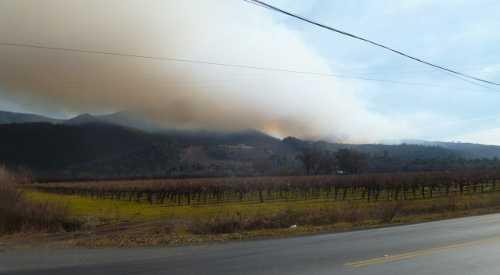
CA-LNU-BECKS 296 acres & 100% contained. Full containment tomorrow.

 Lake County Fire / CAL FIRE working a wildland fire that resulted when a control burn at a vineyard escaped.

Updates: 
1-23 1000hrs: 296 acres and 100% contained.
1630hrs: #BecksFire now 300 acres & 50% contained. Full containment tomorrow.
1500hrs: AQ Advisory has been issued due to heavy smoke in the Redwood Valley and Willits Areas. Source is the #BecksFire in Lake County.
1400hrs: Reports indicating the fire is now possibly 300 acres, 10 percent contained.
1330hrs: Fire on Mt. Konocti now reported to be 250 acres with potential to grow to 600 acres.
1300hrs: 150+ acres? moving toward the peak of Mt. Konocti and away from Kelseyville and structures.
12:45hrs: Request for 2 engine strike teams to meet at the base of Mt. Konocti.
1230hrs Request for 3 additional crews, a strike team, a dozer and more overhead command staff.
1200hrs: 90 acres
1100hrs: 5 - 7 acres heavy brush, with structure threat.


Eric Wheaton took this picture of an escaped control burn in the area of Red Hills Road near Kelseyville, Calif., on Tuesday, January 22, 2013.
Location: Mt. Konocti area Lake County- Red Hills Vineyard, 7900 Highway 29.
Acres: 150 (UC)
ROS: Initialy slow rate of spread, with difficult access.
ROC: 5 - 7 acres, heavy brush
Structures: Yes
Special Hazards: Lookout/Radio towers on mountain top. Heavy brush 
Resources: Multiple LG engines, calling for code 3 dozers and hand crews.
Radio Frequencies: CMD: LNU East TAC: VFIRE22
Weather Info:
Other Comments: Started from a burn pile at vineyard, Ash from the fire was reported to be falling in the Kelseyville area, as well as in Lakeport and Upper Lake.

Road Closures: Lake County Public Works said Konocti Road, at the base of Mt. Konocti – past Mt. Vista Middle School closed to all traffic due to the fire.

Twitter Buttons

****REMINDER**** Every fire has the ability to be catastrophic. The wildland fire management environment has profoundly changed. Growing numbers of communities, across the nation, are experiencing longer fire seasons; more frequent, bigger, and more severe, fires are a real threat. Be careful with all campfires and equipment.

"I am a firm believer in the people. If given the truth, they can be depended upon to meet any national crisis. The great point is to bring them the real facts, and beer." --Abraham Lincoln

View blog top tags
---------------------
CLICK HERE TO GO BACK TO TOP OF CALIFORNIA FIRE NEWS HOME PAGE

Subscribe via email to California Fire News - Keep track of Cal Fire News

Enter your email address:

Delivered by FeedBurner