Tuesday, April 2, 2013

EMS News: FDNY EMT shoves NYPD cop out of ambulance, gets arrested


Andrew Haley told cop to leave vehicle as he was treating patient


NEW YORK — An FDNY medic was briefly arrested yesterday for allegedly shoving a cop from the back of an ambulance while a stricken woman was being treated inside, sources said.

Andrew Haley got into a beef with the transit officer when ambulances responded to the subway station at Fourth Avenue and Pacific Street in Boerum Hill at around 8:30 a.m. to aid a 59-year-old woman with chest pains.

Haley was about to give her an electrocardiogram when the unidentified cop asked her for information.

Haley then told the officer to leave and to shut the ambulance door because the unidentified woman's breasts would be exposed during the procedure, the sources said.

When the cop refused, Haley allegedly shoved him and the two got into an argument, with the cop shouting, "Get your hands off me!" and each calling for a supervisor, the sources said.

Cops cuffed Haley and he was taken to Transit District Precinct 32 nearby, while other EMS workers brought the woman to the hospital.

"The EMT was arrested for obstructing governmental administration. That arrest was voided," Police Commissioner Ray Kelly said later yesterday.

"Some dispute arose inside the ambulance, the EMT wanted the police officer to leave. The police officer didn't want to leave. So that is the nature of the dispute."

Haley, who has been commended by the department for his lifesaving heroics at least twice, was led out of the station house at about 1 p.m. by an FDNY captain. He could not be reached for comment.

Source: NY Post Link:


Graffiti Artist found hanging from Sacramento high-rise

Man found hanging from Sacramento high-rise
Police and fire crews responded after receiving a call at 7:44 a.m

The Associated Press
SACRAMENTO, Calif. — Sacramento police say a man who was found dead hanging by a rope off an 18-story Sacramento high-rise appears to have been a graffiti tagger.

Fire Battalion Chief Marc Bentovoja says the man appears to have died accidentally of asphyxiation when he created a harness from the rope and lowered himself down the east side of the office building.

A police department dispatch supervisor said Monday afternoon that investigators found a can of spray paint and a tool for etching glass on the part of a balcony where the ropes were anchored.

Police and fire crews responded after receiving a call at 7:44 a.m. Rescue personnel retrieved the body shortly after 9 a.m.

The coroner's office is not releasing the man's identity pending notification of next of kin.

WTC Health Program Enrollment for Pentagon, Shanksville Responders


 World Trade Center Health Program Enrollment for Pentagon, Shanksville Responders
March 29, 2013 – Beginning May 1, 2013, fire fighters who responded to the September 11, 2001, terrorist attacks at the Pentagon and Shanksville, Pennsylvania, crash sites will be eligible to enroll in the World Trade Center Health Program (WTCHP).

To be eligible for the WTCHP, first responders, including fire fighters, must have participated in rescue, recovery or clean-up work for a minimum amount of time. Pentagon responders are eligible if they participated at the site for at least one day beginning September 11, 2001, and ending November 19, 2001. Shanksville responders must have participated at that site for at least one day beginning September 11, 2001, and ending October 3, 2001.

The eligibility dates are based on a review conducted by the WTCHP administrator and the program’s Scientific/Technical Advisory Committee, which took into account the estimated duration of rescue and recovery work performed at the sites and data from environmental sampling.

The WTCHP is a federally funded program established by the Zadroga 9/11 Health and Compensation Act of 2010 that provides long term medical care for workers and survivors of the September 11 terrorist attacks. Participants of the program receive free annual medical exams and free treatment for any diagnosed 9/11-related health condition.

Enrollment for the program is currently open for all fire fighters who worked or volunteered their time at the World Trade Center site in New York City. The IAFF is currently developing an online resource with information for IAFF members about the program, enrollment outreach activities and up-to-date information on 9/11-related health issues. 

For more information on the eligibility requirements for Shanksville and Pentagon responders, click here.

For more information on the WTCHP, click here.

Click here to enroll in the WTCHP. 


Expiring Federal SAFER Grant Cuts Marysville Firefighters

 When SAFER Runs Out, CalFire-Marysville Crews Cut To Unsafe Levels


Staffing will drop from nine to six when the SAFER grant runs out next week.


April 02-- CalFire-Marysville will have fewer firefighters on duty once a grant that made up for 2010-11 staffing cutbacks runs out next week.

As of Sunday, CalFire-Marysville full-time staffing will drop from nine to six -- or three full-time firefighters per shift to two.

Having a captain and two firefighters on duty is the "most desirable and effective" staffing level for the department, Battalion Chief Mike Carr said last week.

But with a Federal Emergency Management Agency grant running out, the number will go to two, a level Carr called "a concern."

"I am not saying we will be standing outside watching a building burn," Carr said.

"But there will be times that we will be spread very thin," he said. "In the long run, it will reduce effectiveness."

Two full-time CalFire-Marysville firefighters will be transferred to other CalFire stations and a third temporary firefighter will be laid off.

The reduction will likely mean a heavier reliance on the department's volunteer and reserve programs, along with mutual aid agreements with other departments.

Carr, however, emphasized the department will continue to respond to all emergency calls. Where the reduction will especially hurt will be in code enforcement, public education and equipment maintenance, he said.

"Things will fall off," Carr said. "But they will fall off from the bottom up."

Marysville has contracted with CalFire for the past 13 years to provide fire and rescue service in the city.

The city allocates about $1.1 million a year to the state for operation of the department.

Budget cutbacks in 2010-11 reduced staffing levels to two firefighters per shift for about 10 months until the two-year $700,000 FEMA grant brought the level back up to three.

Mayor Ricky Samayoa said he is concerned about the staffing decline.

"I think all those education programs, responding to complaints, making sure restaurants are in compliance, developing emergency plans are things of importance," he said. "When it comes to a two-person level, I get a little worried. They tend to be the first responders."

City Manager Walter Munchheimer said city officials intend to apply for another two-year FEMA grant to make up the shortfall, but that won't be done until August for the next grant funding cycle.

"The difference between two and three isn't so much that the community would notice," Munchheimer said. "But it puts different demands on the department and how it is managed.

"It's very likely the volunteers would be called on perhaps more than in the past," he said.

Carr noted that with recent federal budget cutbacks, there is no guarantee a new grant application will be successful.

"At best, these are Band-Aids," Carr said of the grants.

"The real solution is a dedicated funding level for staffing."

As a comparison, Yuba City Fire Department has three firefighters on duty 24 hours a day, seven days a week. Department spokesman Bill Fuller noted less-experienced, temporary firefighters fill some of those spots because of budget shortfalls.

Samayoa said the staffing reduction is an example of economic issues the city faces. He said the city is "not at a point where we can cut further."

"All we could do is shuffle funds around," he said. "We have a shrinking pot of money.

"If citizens want more fire, we would have to reduce from somewhere else," Samayoa said.

Reduction could lead to some bigger fires

CalFire Battalion Chief Mike Carr said reducing the number of full-time firefighters per shift would have more effect on responding to fires than calls for medical aid.

And he acknowledged there will be times when shifts overlap and there will be three firefighters on duty, just as there are occasions when there were four with staffing levels at three per shift.

But Carr said when there are only two, the biggest effect will be in responding to fires.

"Small fires might get to be medium fires and medium fires might get to be bigger fires," he said.

Under Cal/OSHA regulations, firefighters are not allowed to enter a burning structure unless two go in and two remain outside. With three on duty, along with a battalion chief, that can be fulfilled.

But with only two on duty, even with the battalion chief, a volunteer or reserve would also have to be present.

"We are depending on someone else to fulfill that requirement," Carr said.

He emphasized the exception to the Cal/OSHA "two-in, two-out" rule is that if there is reasonable belief there is somebody inside a burning building. In that case, the rule doesn't apply, Carr said.

Another effect, he said, will be that in responding to a structure fire with three full-time firefighters, more pieces of equipment can be brought.

Two 'disappointed' with transfer from Marysville

Two CalFire-Marysville firefighters will be transferred to other CalFire stations once FEMA grant funding runs out on Sunday.

Firefighters Bryan Carter and Jeff Fuentes both live in Rocklin and have been with the department since 2008, but will be moving on to other stations.

Both Carter and Fuentes were moved to different CalFire stations when department staffing was reduced in after 2010-11 budget cuts.

"We both have turned down promotions to stay here," Carter said. "We like who we work with. We are both disappointed."

Carter said he will likely be assigned to the CalFire station at Alta while Fuentes said he will probably be assigned to Columbia Hill.


Source: http://www.appeal-democrat.com/news/marysville-124327-grant-calfire.html
CAL FIRE Marysville

CAL FIRE Marysville @MarysvilleFire

Official Site for CAL FIRE Marysville Fire Department.
Marysville, California · http://www.marysville.ca.us/fire.asp?did=10

TCU 0800: Five New Firefighters Welcomed Aboard This Morning

 Cal Fire adds five firefighters to force
Five new firefighters joined the Tuolumne-Calaveras Unit of the California Department of Forestry and Fire Protection – commonly known as Cal Fire – thanks to an agreement among Cal Fire, Tuolumne County Fire Department and Groveland Community Services District.

Acting Cal Fire Chief Steve Lawshe said, “We are very excited to welcome the Groveland Fire District and its firefighters into the Cal Fire/TCFD family and look forward to a great relationship to provide fire protection to residents of the district and surrounding area.”
The agreement, which took effect Monday at 8 a.m., begins a new cooperative fire protection arrangement to provide fire and emergency services.
Prior to the agreement, the five firefighters were employed by the Groveland Community Services District.
Minimum staffing at the Groveland fire station will continue to be two firefighters on duty 24 hours a day.
Personnel from the three departments have been working on details during the transition phase for the past several months to ensure a smooth transfer of operations.
The Groveland Community Services District serves an area of about 15 square miles, including Groveland, Pine Mountain Lake and Big Oak Flat in southern Tuolumne County.
In addition, the department responds outside the district, assisting Tuolumne and Mariposa County Fire Departments, Cal Fire and the U. S. Forest Service. The district responds annually to more than 500 calls.


Edited Info Source: Calaveras Enterprise -  http://www.calaverasenterprise.com/news/article_73fb5e52-9bab-11e2-a58c-0019bb2963f4.html
Cal Fire TCU ECC 
785 Mountain Ranch Rd, San Andreas, CA 95249

 -  

Environmental Health: Cancer Risk? You’re Standing on It! Health Risks of Coal-Tar Pavement Sealcoat

 Estimated lifetime cancer risk is substantially higher for people that live near coal-tar-sealcoated pavement

Coal-tar-based sealcoat, a potent source of polycyclic aromatic hydrocarbons (PAHs), is used commonly on residential driveways in the central, southeastern, and northeastern U.S. In Lake in the Hills, Ill., about 90% of residential driveways are sealcoated, as shown here.

Coal-tar-based sealcoat—a product marketed to protect and beautify asphalt pavement—is a potent source of polycyclic aromatic hydrocarbons (PAHs) to air, soils, streams and lakes, and homes. Does its use present a risk to human health?

Results from a new study by researchers from Baylor University and the USGS indicate that living adjacent to a coal-tar-sealed pavement is associated with significant increases in estimated excess lifetime cancer risk, and that much of the increased risk occurs during early childhood.

What are sealcoat, coal tar, and PAHs?

Pavement sealcoat—also called sealant or driveway sealer—is a black liquid sprayed onto the asphalt pavement of many residential driveways, parking lots, and even some playgrounds. Sealcoat used in the central, southern, and eastern U.S. commonly contains coal-tar pitch, and sealcoat used in the western U.S. commonly contains asphalt. Coal-tar pitch, the residue remaining after distillation of coal tar (a byproduct of the coking of coal), is a known human carcinogen and contains about 200 different PAHs. Coal-tar-based sealcoat typically is 20 to 35 percent coal-tar pitch and contains from 50,000 to 100,000 milligrams per kilogram (or parts per million) PAHs, about 1,000 times higher than PAH concentrations in asphalt-based sealcoat products, and hundreds of times higher than PAH concentrations in tire particles, used motor oil, or other urban sources. At least seven PAHs, including benzo[a]pyrene, are probable human carcinogens.


The pavement of many parking lots is coated with coal-tar-based sealcoat, which is marketed to increase the longevity of the underlying asphalt and improve appearance. Car tires grind the dried sealcoat to a fine powder that is a potent source of polycyclic hydrocarbons (PAHs). The sealcoat particles wash down storm drains, are blown onto adjacent soil and pavement, and are tracked into homes on the soles of shoes.

PAHs from coal-tar sealcoat find their way into soil and house dust

Friction from vehicle tires grinds pavement sealcoat into small particles, which are incorporated into the dust on the pavement surface. Dust on coal-tar-sealed pavement contains PAHs at concentrations that are hundreds of times higher than those in dust on concrete or unsealed asphalt pavement. Some of that contaminated dust is transported by wind, rain, and snowplows to nearby soil, and some is tracked into homes, where it becomes part of the house dust.

People, especially children, are exposed to PAHs in soil and housedust

We all consume soil and dust through what is called incidental (non-dietary) ingestion, which occurs when we put our hands or objects into our mouths. Incidental ingestion is a pathway to exposure to many chemicals, especially for children. The study focuses on incidental ingestion of the seven cancer-causing PAHs. A single number known as the benzo[a]pyrene equivalent (BaPEQ) was determined that represents the cancer-causing concentration of the seven PAHs combined. Using existing data, a representative BaPEQ was determined for soil adjacent to coal-tar-sealcoated pavement and for house dust in nearby residences, and also for soil adjacent to unsealed asphalt pavement and house dust in nearby residences. The average estimated lifetime BaPEQ dose for someone living adjacent to coal-tar-sealcoated pavement was 38 times greater than for someone living adjacent to unsealed asphalt pavement. About one-half of that dose occurs during childhood, that is, 0 to 6 years of age.

Estimated lifetime cancer risk is substantially higher for people that live near coal-tar-sealcoated pavement


USGS researchers collect a sample of dust from a sealed parking lot for analysis of PAHs.

Excess lifetime cancer risk—the probability that an individual will develop cancer by age 70 because of exposure to a contaminant—was determined for individuals who spend their lifetime living adjacent to pavement with coal-tar-sealcoat (for example, a sealcoated driveway or a sealcoated parking lot), those who spend just the first 6 years of their life living adjacent to pavement with coal-tar-sealcoat, and those who spend their lifetime (70 years) living adjacent to unsealed asphalt pavement (urban background exposure).

For someone who spends their entire lifetime living adjacent to coal-tar-sealcoated pavement, the average excess lifetime cancer risk is estimated to be 38 times higher than the urban background exposure. More than one-half of the risk occurs during the first 18 years of life, and most of it (84 percent) is from ingestion of soil. The estimated lifetime cancer risk also is elevated for someone who spends just the first 6 years of their life living adjacent to coal-tar-sealed pavement—about 25 times higher than urban background exposure.


A USGS researcher vacuums up a sample of house dust for analysis of PAHs. Concentrations of PAHs in house dust from residences adjacent to parking lots with coal-tar-based sealcoat were 25 times higher than in housedust from residences adjacent to parking lots with other types of pavement surfaces.

For the average individual who lives adjacent to coal-tar-sealed pavement for either their entire life or just the first 6 years, the excess lifetime cancer risk is estimated to be greater than 1 in 10,000. Estimated cancer risk associated with coal-tar-sealcoat is even higher for children that consume larger-than-average amounts of soil and dust. In general, the U.S. Environmental Protection Agency considers excess cancer risks greater than 1 in 10,000 to be sufficiently large that some sort of remediation is desirable.


Source: USDA - http://www.usgs.gov/blogs/features/usgs_top_story/youre-standing-on-it-health-risks-of-coal-tar-pavement-sealcoat/
BY: SPENCER WILLIAMS (SP_WILLIAMS@BAYLOR.EDU), BARBARA MAHLER (BJMAHLER@USGS.GOV), PETE VAN METRE (PCVANMET@USGS.GOV), JENNIFER LAVISTA (JLAVISTA@USGS.GOV)

Coffee Break Training: Hazardous Materials: Indoor Parking and Servicing of Liquefied Petroleum-Gas Transport Vehicles

 Learning Objective: The student shall be able to describe the construction and operational requirements for indoor parking and servicing of LP-Gas transport vehicles when the vehicles are under the control of their owner.

When LP-Gas transport vehicles are parked or serviced in separate structures indoors by the owner/operator, the building must meet the construction requirements of  National Fire Protection Association 58, Liquefied Petroleum Gas Code. A “separate” structure is one that is not attached to any

other buildings or structures on the site.

Separate buildings or structures are limited to a single story in height and are required to have noncombustible walls, floors, ceilings and roofs. The exterior walls and ceilings should be made of lightweight material designed for explosion venting, or, if they are made of heavy construction materials such as solid brick masonry, concrete block, or reinforced concrete construction, they should be equipped with explosion venting windows that have an explosion venting area of at least 1 foot (0.1 meter2) for each 50 feet3  (1.4 m3) of the structure’s enclosed volume.

The floor of separate structures should not be below ground level. Due to the fact that LP-Gas vapors are heavier than air and will settle if released from a container, any space beneath the floor should be solidly filled or have a perimeter that is entirely unenclosed to allow ventilation.

The structure should be ventilated using air inlets and outlets with the lowest part of the vent located not more than 6 inches (150 millimeters) above the floor. 
Ventilation should be provided in accordance with the following:

  • Where mechanical ventilation is used, the rate of air circulation should be at least 1 foot3 /min·foot2 (0.3 m3/min·m2) of floor area.
  • Outlets should discharge at least 5 feet (1.5 m) from any opening into the structure or any other structure.
  • Where natural ventilation is used, each exterior wall should be provided with one opening for each 20 feet (6.1 m) of length.
  • Each opening should have a minimum size of 50 inches2 (32,250 mm2), and the total of all openings should be at least 1 inch2 /foot2 (6,900 mm2/m2) of floor area.

If the structure is used for storage only, natural ventilation is usually adequate. Mechanical ventilation is more reliable than natural ventilation and is preferred for buildings where liquid LP-Gas transfer occurs.

For more information, refer to NFPA 58, Liquefied Petroleum Gas Code

NFPA Coffeee Break Training No. FP-2013-14 April 2, 2013 http://www.usfa.fema.gov/downloads/pdf/coffee-break/cb_fp_2013_14.pdf

San Jose: Man Drives Car Into Wal-Mart And Attacks Customers


Man rams car into Calif. Wal-Mart, attacks customers

The unidentified driver then got out of his car and used a blunt object to attack people

SAN JOSE, Calif. — A man in a large red sedan hit two cars in the parking lot of a San Jose Wal-Mart before ramming the car through the front of the store then assaulting customers inside, officials said. The attack injured four people, one of them seriously.
The man crashed the Oldsmobile Cutlass through the storefront near the pharmacy Sunday and collided with a beer display before stopping, police and witnesses said.
The unidentified driver then got out of his car and used a blunt object to attack people, San Jose police Officer Albert Morales said. The driver was arrested when officers arrived.
Investigators have not determined how fast the driver — described as a man in his 30s — was going at the time of the crash but the car went about 20 feet into the Wal-Mart Supercenter that had about 70 people inside in San Jose, Morales said.
One person suffered what Morales described as serious injuries. He did not know the extent of the injuries to the three other people but said they were not life-threatening. The injured included a store employee.
There was no immediate word about what motivated the suspect.
Customer Sharon Kaye told the San Jose Mercury News the driver sideswiped her car as he made several runs around the parking lot before driving between poles at the entrance and crashing into the store.
"At first, I thought I may have done something to anger him while driving," she said. "But then I realized he was out to get into the store."
After the crash, the entrance to the Wal-Mart was roped off with yellow police tape, and workers put up large boards covering the automatic doors where the car had entered.
A Wal-Mart spokeswoman told the Mercury News that the store remained shut down for several hours, and an employee was among those hurt.
"We're obviously very concerned about the associate who was injured," spokeswoman Kory Lundberg said.
Shopper and witness Tianna Doan told the newspaper the employee was a cashier who was hit with the object and had a head injury.
Calls to the store by The Associated Press went unanswered Sunday.
No information was available at press time regarding condition of the beer display


Monday, April 1, 2013

Yucaipa: Aircraft Down at Yucaipa business


  Plane Crash Is April Fool's Prank
YUCAIPA, Calif. -- It's the plane crash that wasn't in Southern California.
Bill Cheesman Jr. set up a fake plane crash at his Yucaipa business on Monday as an April Fool's joke. He said the scene has drawn lots of comments. He alerted the San Bernardino County Sheriff's Department before the sun rose on his prank.
A Yucaipa businessman staged an elaborate April Fool's joke on Monday.
Billy Cheesman Jr. used a forklift to arrange a small aircraft on the fence that runs in front of his equipment rental business, as if it had nosedived there.
He also strung yellow caution tape around to make it resemble a crash scene.
Cheesman says someone gave him the two-seat experimental plane and he's been trying to figure out what to do with it.
He notified the San Bernardino County Sheriff's Department before he set up the prank at Redlands Yucaipa Rentals.

Source: The Riverside Press-Enterprise - http://bit.ly/YQ8fyA


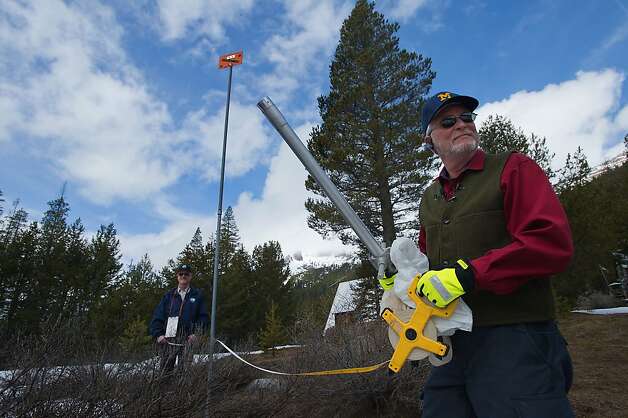
California Snow Survey: Snowpack 52% of normal

Snow Survey Dramatically Shows Dry Conditions

Snowpack water content 52 percent of normal
Keith Swanson (left) and Frank Gehrke prepare to take water samples at Phillips Station in El Dorado County.
Photo: Randall Benton, RBenton@sacbee.com
SACRAMENTO – Snow surveyors today reported that water content in California’s snowpack is only 52 percent of normal, with the spring melt season already under way.
“With most of the wet season behind us, this is more gloomy news for our summer water supply,” said DWR Director Mark Cowin. 

After a record dry January and February in much of the state, DWR on Friday decreased its water delivery estimate, or allocation, from 40 to 35 percent of requested amounts from the State Water Project (SWP).

The 29 public agencies that purchase SWP water requested just over four million acre-feet of water for this calendar year. Collectively, the agencies supply more than 25 million Californians and nearly a million acres of irrigated agriculture.

Pumping restrictions imposed this winter to protect Delta smelt and salmon are another reason for the low water delivery estimate. November and December were unusually wet, but between November 1 and February 28, fishery agency restrictions prevented DWR from pumping more than 550,000 acre-feet of water from the Sacramento-San Joaquin Delta to store in San Luis Reservoir. Today San Luis – a summer supply pool for both the State Water Project and the federal Central Valley Project – is 63 percent full.

“This is the kind of conflict we are working to resolve through the Bay Delta Conservation Plan,” said Cowin.
The Bay Delta Conservation Plan would reduce harm to fish from altered stream flows caused by the south Delta pumps serving the SWP and Central Valley Project. Pumping there at times causes reverse flows which may disorient or entrain fish. The comprehensive plan’s large-scale habitat restoration would also improve Delta conditions for fish and wildlife.

The November and December storms built California’s snowpack water content to 134 percent of normal by January 2, when DWR and cooperating agencies conducted this season’s first manual survey. Manual surveys and electronic readings have recorded the water content decline since dry weather set in. Statewide, the season’s second manual survey on January 29 found the snowpack water content at 93 percent of normal for the date. On February 28, the season’s third manual survey found the snowpack water content at 66 percent of average Today’s survey – finding snowpack water content at only 52 percent of normal -- is particularly significant because this is the time of year the snowpack normally is at its peak before slowly melting with warming weather. 

The season’s final survey on or about the first of May will check the rate at which the snowpack is melting. Snow normally provides about a third of the water for California’s homes and farms as it melts into streams, reservoirs and aquifers.

Electronic snowpack readings may be found at:
http://cdec.water.ca.gov/cgi-progs/snow/DLYSWEQ
Electronic reservoir level readings are available at:
http://cdec.water.ca.gov/cgi-progs/products/rescond.pdf

Survey: California snowpack only 52 percent of normal

By TIM HEARDEN - Capital Press

REDDING, Calif. - A much-awaited snowpack survey March 28 merely confirmed what California water officials already knew: it's turned out to be a dry year.

After a record dry January and February in much of the state, the California Department of Water Resources found the snowpack water content to be only 52 percent of normal for this time of year.

Whatever April brings, that's probably as good as it's going to get because the snow typically starts melting by now, said Ted Thomas, the DWR's chief spokesman.

"Most likely this will be the peak," Thomas said. "The bright spot is thanks to storms in November and December, our reservoirs are near or slightly above their historical average in storage."

Indeed, the total storage statewide is at 97 percent of normal, according to the DWR's California Data Exchange Center. Shasta Lake, the centerpiece of the Central Valley Project, is slightly above its average for this time of year. The same is true for Lake Oroville.

However, the light snowpack prompted officials last week to further cut State Water Project allocations from 40 percent to 35 percent of requested amounts. The project supplies water to more than 25 million Californians and nearly a million acres of irrigated agriculture, according to a news release.

Pumping restrictions imposed this winter to protect Delta smelt and salmon are another reason for the low water delivery estimate, officials said.

Likewise, the U.S. Bureau of Reclamation announced it was decreasing agricultural water service contractors' allocations from 25 percent to 20 percent of normal supplies south of the Sacramento-San Joaquin River Delta. Ag contractors north of the Delta will get 75 percent of their contract supply of 443,000 acre-feet, the agency announced.

Farmers are already feeling the pinch from the lack of rainfall. Greg Hawes, who grows wheat and walnuts in the Redding area, said his farm has received barely enough rain for the season. And he knows it could be worse.

"I was down in the Los Banos area three weeks ago and holy smokes," he said. "There's fields there just drying up. I hope April's wet."

The dry conditions come after November and December storms pushed California's snowpack water content to 134 percent of normal as of Jan. 2, when the DWR and other agencies did the season's first manual survey.

But by the third manual survey in February, the snowpack water content had dwindled to 66 percent of average, the state's news release explained.

Some help could be on the way.

The federal Climate Prediction Center foresees above-average chances of precipitation in much of California through at least the first half of April, although more long-range forecasts show a return to a dry pattern.

"A wet April could make a difference," Thomas said. "The long-range forecast is for below-average precipitation, but definitely a wet April could improve things."

March rainfall:

Here are the March and seasonal rainfall totals and comparisons to normal for selected California cities, according to the National Weather Service. Totals are as of March 28:

Redding: Month to date 2.2 inches (normal 4.07 inches); season to date 22.87 inches (normal 29.3 inches)

Eureka: Month to date 2.67 inches (normal 4.56 inches); season to date 27.85 inches (normal 34.04 inches)

Sacramento: Month to date 0.66 inches (normal 2.56 inches); season to date 13.27 inches (normal 16.29 inches)

Modesto: Month to date 0.17 inches (normal 1.9 inches); season to date 7.64 inches (normal 11.25 inches)

Salinas: Month to date 0.37 inches (normal 2.09 inches); season to date 8.61 inches (normal 11.29 inches)

Fresno: Month to date 0.33 inches (normal 1.88 inches); season to date 5.19 inches (normal 9.76 inches)
Source: http://www.capitalpress.com/newsletter/TH-water-w-photo-infobox-032913
more: http://www.sfgate.com/science/article/California-s-small-snowpack-raises-chills-4392785.php#ixzz2PEtHrPfv

Twitter Buttons

****REMINDER**** Every fire has the ability to be catastrophic. The wildland fire management environment has profoundly changed. Growing numbers of communities, across the nation, are experiencing longer fire seasons; more frequent, bigger, and more severe, fires are a real threat. Be careful with all campfires and equipment.

"I am a firm believer in the people. If given the truth, they can be depended upon to meet any national crisis. The great point is to bring them the real facts, and beer." --Abraham Lincoln

View blog top tags
---------------------
CLICK HERE TO GO BACK TO TOP OF CALIFORNIA FIRE NEWS HOME PAGE

Subscribe via email to California Fire News - Keep track of Cal Fire News

Enter your email address:

Delivered by FeedBurner